AI assistants for SMBs: from hype to measurable results
An AI assistant takes over repetitive work: preparing quotes, processing emails, entering data, compiling reports. Here you read what really works today, what it demands from your data and how to start without locking yourself in. Written independently: we sell no AI tools.
- No vendor lock-in · No commissions
- Your data trains no public AI models
- Reply within 1 business day
A digital colleague, connected to your systems
An AI assistant is software that combines language models with your business data and systems to carry out tasks independently: reading an email and booking the order, preparing a quote based on your pricing logic, compiling a report from your ERP. The difference with using ChatGPT on its own: an assistant knows your context and works inside your processes.
For an SMB, AI is not a goal but a tool: the gain is not in the smartest demo but in the dull hours that come back every week.
Generic chatbot
- ✕ Answers based on the entire internet, often too generic or wrong.
- ✕ Does not know your products, prices and customers.
- ✕ No control over who may see or ask what.
Business AI assistant
- ✓ Works within your authorisations and follows your process rules.
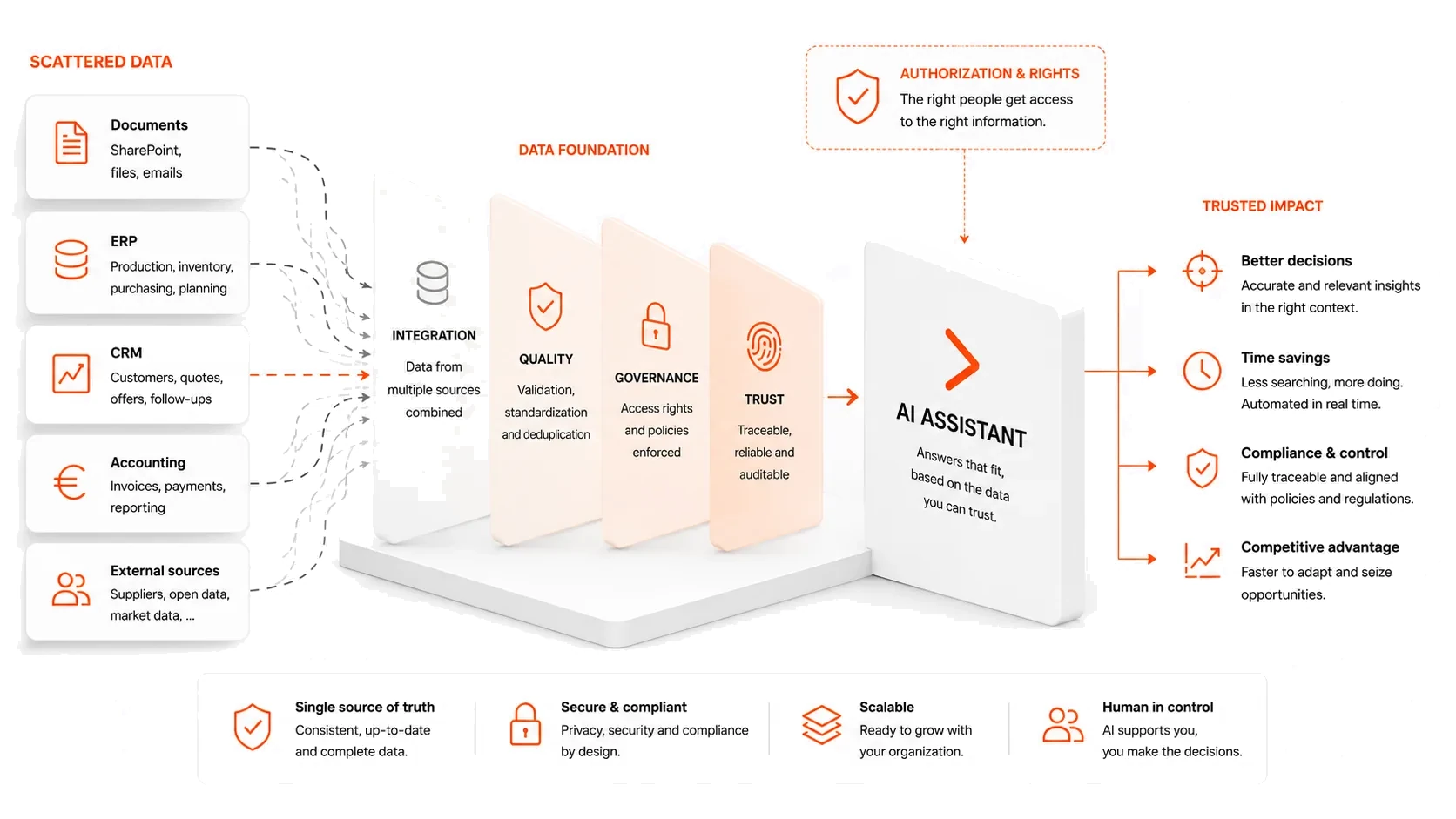
- ✓ Reads your SharePoint, CRM or ERP and answers from your knowledge.
- ✓ Every action is traceable and a person remains accountable.
AI is as good as the data you feed it
An assistant running on polluted or scattered data gives confident answers that are wrong. Before any AI step we therefore test your data foundation: where the knowledge sits, how reliable it is and what the assistant may do with it. This is often half the work and the part vendors prefer to skip.
Just as important are the authorisations: an assistant allowed to read everything will also answer what the director earns or what margin you make on customer X. We frame data access and rights sharply before anything goes live: who may ask what, and on which data the assistant answers.
More on this in our blogs on business data for AI and data silos.
Four places where the hours sit
Sales and quotes
Reading requests, transferring data, preparing a draft quote according to your pricing logic. Sales checks and sends.
Administration
Matching invoices, booking orders, completing master data. The work nobody wants to do but that holds everyone up.
Customer questions
First answers to frequent questions, fed by your own documentation, handing over to a person as soon as it gets tricky.
Reporting
Weekly figures from your ERP or accounting summarised in language management actually reads, without anyone pasting exports.
Starting small is a virtue here
Unlike ERP, you do not have to invest big in one go: a well-scoped pilot shows within weeks whether the business case holds. The real costs sit not in the licences but in the integration with your systems and getting your data in order. So budget for the journey, not the tool.
Did you know the EU AI Act also applies to SMBs?
Most AI assistants for SMBs fall in the lowest risk class, but transparency duties do apply: users must know they are working with AI and you remain responsible for the output. Using your assistant for personnel decisions or credit checks puts you in a heavier regime. We include the AI Act check in the analysis by default, so compliance is no surprise afterwards.
Identity & access
Only the right people get access to the right data and functions.
Data protection
Sensitive information protected through classification, encryption and policy.
Human in the loop
Important decisions and sensitive actions are verified by people.
Prompt protection
Protection against abuse such as prompt injection and unwanted inputs.
Audit logging
All interactions and actions recorded for audit and accountability.
Monitoring
Continuous oversight of the assistant's behaviour, performance and risks.
Four building blocks of a successful AI implementation
Strategy
Determine where AI has the biggest impact and how that ties into your business goals.
Data
Quality, accessible and well-managed data as fuel for every application.
Technology
The right architecture to build safely, scalably and without lock-in.
Governance
Keeping AI safe, reliable and compliant with laws and regulations, permanently.
None of these pillars stands alone: successful implementations happen when strategy, data, technology and governance stay aligned.
The pitfall: the pilot that never reaches production
Most AI projects do not strand on the model but on what surrounds it: data that is not ready, nobody checking the output, a tool running apart from the systems where the work really happens. What remains is an impressive demo that quietly switches off after three months.
Just as often it strands on people: employees who distrust the tool or fear for their job simply do not use it. That is why the human factor belongs in the analysis: who will work with it, what changes for them and what they need to trust it. SEMANU starts on the process and data side, with an exit plan from day one so you are not stuck with a vendor when the landscape shifts again next year. See also our blog on the vendor exit.
From idea to working assistant
SEMANU specifies and safeguards, a vendor or build partner delivers the assistant. Every phase ends with a go or no-go, so you never invest further than the results justify. For the multi-year line there is the AI roadmap within software strategy.
Where we make the difference
- AI use case analysis with feasibility check
- Business value estimate per use case
- Risk and compliance focus (GDPR, ethics, accuracy)
- Data quality audit as a precondition for AI
- Human-in-the-loop and escalation design
- Implementation approach with phasing
Frequently asked questions about AI assistants
What is an AI assistant?
An AI assistant is software that combines language models with your business data and systems to carry out tasks independently, from processing emails to preparing quotes. Unlike a standalone chatbot, an assistant knows your context and works inside your processes. People remain accountable for the output.
What does an AI assistant cost?
Licences are rarely the problem; the costs sit in the integration with your systems and getting your data in order. A well-scoped pilot shows within weeks whether the business case holds, before you invest bigger. Ask for an indication in the scope call.
Is our data good enough for AI?
That is the right first question. An assistant running on polluted data gives confident answers that are wrong. In the analysis we test where your knowledge lives, how reliable it is and what it takes to make it usable.
How long does an AI project take?
A well-scoped pilot stands in four to eight weeks; rollout into the real process then follows in months, not years. The pace depends mostly on the state of your data and the integrations with your systems.
What does the EU AI Act mean for an SMB?
Most SMB applications fall in the lowest risk class, but transparency is mandatory and you remain responsible for the output. Applications around personnel or credit fall under a heavier regime. An AI Act check belongs in the analysis by default.
Does an AI assistant replace our employees?
In practice it takes over the repetitive part of existing roles, not the roles themselves. The gain sits in hours freed up for work customers actually notice. Companies that do this well put AI next to their people, not opposite them.
What about privacy and GDPR when we connect an AI assistant?
Your business data stays yours. We only advise solutions where data is processed within the EU and is not used to train external AI models. Authorisations determine who may ask the assistant what, and every interaction is auditable.
You might also be interested in this
SEMANU is an independent software advisory firm for SMBs: we sell no software and receive no vendor commissions. Read how we work as an independent software advisory firm.